
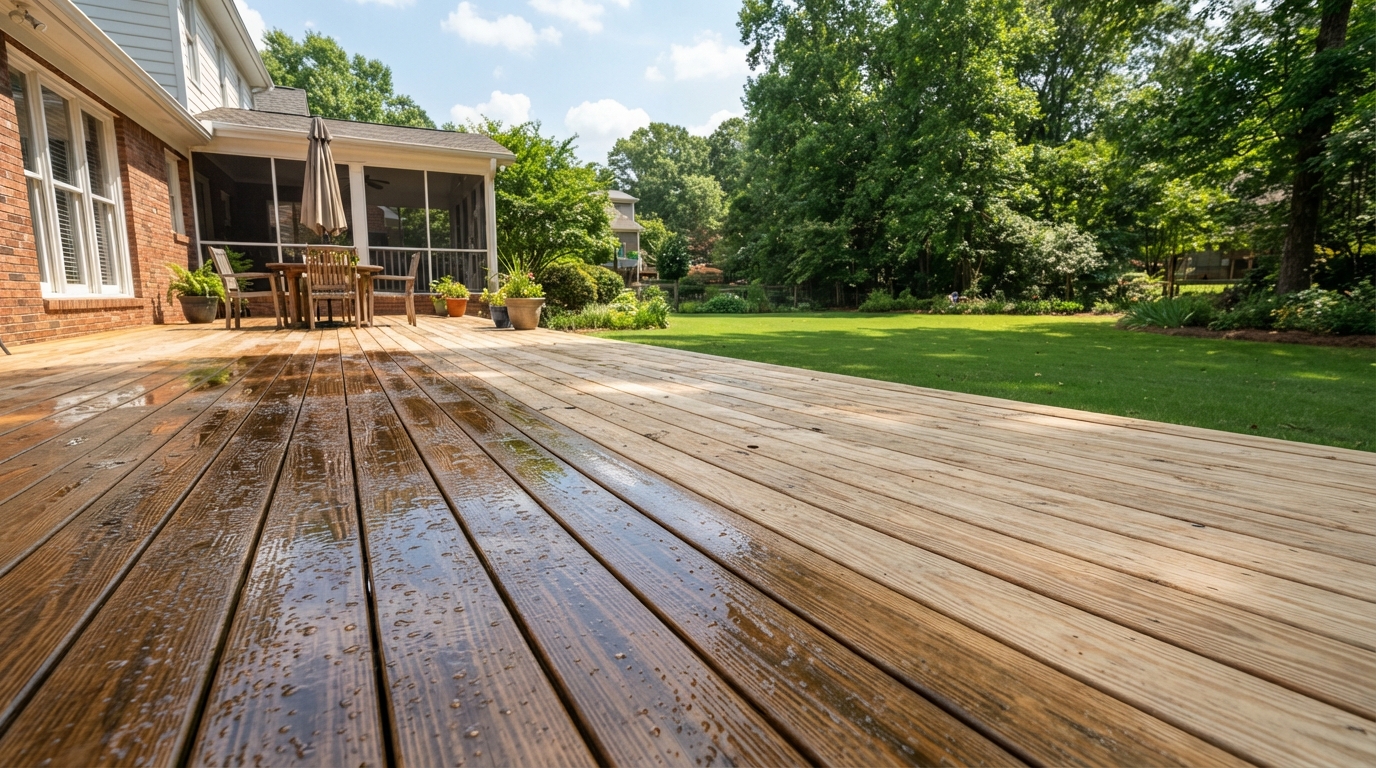
How Long Does a Deck Need to Dry After Pressure Washing Before Staining?
Most decks need 48 to 72 hours to dry before staining, but Cumming's humidity, wood species, and shade can push that window well past three days. Here's how to know for sure.
Most Decks Need 48 to 72 Hours to Dry Before Staining
That freshly washed deck looks great right now. Clean wood, no grime, and you're already eyeing that can of stain in the garage. We get it. Homeowners across Cumming, GA and Forsyth County ask us this same question every week. And our answer doesn't change: put the stain down. Wait. The number we keep coming back to is 48 to 72 hours. That's how long most decks need before the wood is actually ready to accept stain.
But that number isn't a guarantee. It's a starting point.
Here's the thing. Wood is porous. A pressure washer doesn't just rinse the surface. Water soaks deep into the fibers, way past what you can see or feel. The outside might seem dry in a few hours. Doesn't mean the inside is. Stain needs to penetrate into the grain to bond correctly, and if there's still moisture trapped in those fibers, the stain just sits on top. Peeling. Bubbling. A finish that fails within one season.
We pulled up a failed stain job on a pressure-treated pine deck in Cumming last spring. The homeowner had waited only 24 hours after washing. Surface looked dry. When we checked with a moisture meter, the reading was still above 18 percent. Well past the safe threshold. The stain had already started peeling at the edges, and that deck was less than three months old.
We see this constantly.
A little patience upfront would've saved that homeowner a full weekend of stripping and reapplying. The Forest Products Laboratory says wood meant for exterior finishes should measure below 15 percent moisture content before stain or sealant goes on. Many professional applicators aim for 12 percent or lower just to build in a safety margin.
A moisture meter is the only way to know for certain. Press the two pins into the wood, read the number. No guessing. No wiping the deck with your hand and calling it good. We've tested hundreds of decks across Forsyth County over the years, and we carry one on every job. We don't open a can of stain without it.
So why does the 48 to 72 hour range exist at all? Wood species, board thickness, and weather conditions at the time of washing all push that number around. Thinner decking boards on a hot, low-humidity afternoon in July will dry faster than thick, older boards washed on a cloudy morning in October. Pressure-treated lumber holds more moisture than cedar or redwood just by how it's manufactured. Composite decking dries fastest of all because it doesn't absorb water the way natural wood does.
Georgia summers complicate this more than people expect. High humidity slows evaporation. Wash a deck on a day when relative humidity is sitting at 80 percent or above, common here from June through August, and that 48-hour estimate can stretch to 72 hours or beyond. We've seen decks in shaded backyards in Forsyth County take four full days to reach a safe moisture reading after a wash in late summer. Call us at (404) 632-8810 if you want a professional assessment before you stain.
Shade matters too. A deck that gets full afternoon sun will dry in a fraction of the time compared to one tucked under a tree canopy or covered porch overhang. Mostly shaded deck? Add at least a full day to whatever estimate you're working from.
And rain after washing resets the clock entirely. Doesn't matter if your deck sat for 36 hours before a storm rolled through. You're starting over.
The 48 to 72 hour window is real and useful. It's a minimum, not a finish line. Check the moisture. Check the forecast. Then stain.
Several Factors Make Deck Drying Time Longer or Shorter
Most guides tell you to wait 48 hours and move on. That's completely wrong depending on what's happening at your house right now. We've shown up to jobs in Cumming, GA where a deck was ready in 36 hours, and others in Forsyth County where we came back after four days and the wood was still pulling moisture from a shaded corner. The 48-hour rule is a starting point. Not a finish line.
Wood species is one of the biggest variables, and almost nobody talks about it enough. Pressure-treated pine, the most common decking material around here, is dense and holds water deep in the grain. It takes longer to dry than cedar or redwood. Recently installed deck? It may still be holding construction moisture on top of whatever the pressure washer pushed in. We've tested boards on brand-new pressure-treated decks that read above 25 percent moisture content even after several dry days.
That's not ready for stain. Not even close.
The Forest Products Laboratory says wood should reach a moisture content of 15% or lower before applying a penetrating stain, and ideally below 12% for film-forming finishes. A basic pin-type moisture meter, available at most hardware stores, takes the guesswork out completely. We use one on every single job before we open a can.
Sun exposure matters more than most homeowners think. A south-facing deck in full afternoon sun can dry out dramatically faster than a north-facing deck tucked under a tree canopy. We did a job last summer where one half of the same deck, the open side, was ready to stain two days after washing. The shaded half under a pergola took another day and a half. Same deck. Same wash. Totally different drying times.
Humidity catches people off guard the most, especially here in Georgia. When the air is already saturated, think July afternoons where it feels like you're breathing through a wet towel, moisture has nowhere to go. The wood can't release water into air that's already full. Average summer relative humidity in North Georgia regularly exceeds 70% during afternoon hours. At that level, drying slows dramatically compared to the same deck washed on a low-humidity day.
Temperature plays a role too, but it's secondary to humidity in our climate. Warmer air holds more moisture and speeds evaporation, but only when relative humidity is low enough to allow it. A hot, humid day is actually worse than a mild, dry one. We aim for days above 50°F and below 90°F with humidity under 60% when scheduling stain work.
Board thickness and deck age also shift the math. Thicker boards hold more water by volume. Older boards that've been through years of weathering may have micro-cracks and raised grain that trap water in pockets the surface doesn't show. We've probed boards that felt dry to the touch and still read 18-20% moisture inside. That trapped moisture will push a stain coat right back off the surface within days.
If your deck was washed during a rainy stretch, or if it sits in shade most of the day, don't trust the calendar. Trust the meter. Rushing this step is the single most common reason deck stain jobs fail early. And it's completely avoidable.
How to Test If Your Deck Is Dry Enough to Stain
Waiting the right number of days matters. But actually testing the wood before you crack open a can of stain? That matters more. Most guides say wait 48 hours and call it good. Here in Forsyth County, that advice gets people into trouble constantly. We show up to jobs where a homeowner stained too early, and the wood looks blotchy, peeling, or has that gray milky haze trapped underneath. Frustrating. Avoidable.
The Water Droplet Test
Sprinkle a few drops of water onto the deck surface. Watch what happens. If the water beads up and sits on top, the wood's still too wet or the pores are closed. You want to see the water absorb into the wood within a few seconds. That absorption means the wood is open and ready to take stain.
We do this on every job before we even think about staging equipment. Last summer we had a deck in Cumming, GA that looked bone dry on the surface after three days of sunshine. The water beaded right up. Turns out the pressure washing had raised the grain and temporarily closed the pores. We waited one more day and tested again. Absorbed immediately. That one extra day saved the whole project.
The Moisture Meter Reading
A pin-type moisture meter is the most accurate tool for this. Press the pins into the wood in several spots: near the edge, in the middle of a board, and near any shaded areas. The Forest Products Laboratory recommends wood be at or below 15% moisture content before applying most oil-based or water-based stains.
Shaded areas dry slower. Always check those spots last.
If one corner reads 19% while the rest reads 12%, the whole deck isn't ready. You stain to the wettest board, not the driest one. Moisture meters are inexpensive at any hardware store. No meter on hand? The water droplet test is a solid backup. Use both when you can.
What Your Eyes and Hands Tell You
Look at the color of the wood. Freshly pressure washed wood starts out dark and wet-looking. As it dries, it lightens back toward its natural tone. Color looks even and consistent across the whole surface? No darker patches, no wet spots near the ledger board or posts? That's a good visual signal. Not a definitive one. But a good one.
Run your hand flat across the surface. It should feel dry to the touch. Not cool. Not damp. Pay close attention to the spaces between boards. Water pools there and lingers long after the face of the board looks dry. We've seen decks in Forsyth County that tested fine on top but were still holding moisture in the gaps, enough to cause stain failure along every seam.
One Thing Most People Get Wrong
They check the deck once, in one spot, in the middle of the afternoon. That's not a real test. Check in the morning when temperatures are cooler. Check in shaded corners. Check near the house where airflow is restricted. All those spots pass the water droplet test and the moisture meter reads below 15%? You're ready.
If even one area fails, wait. Staining over wet wood doesn't just look bad. It traps moisture inside, which speeds up rot and causes the stain to peel within one season. The North American Deck and Railing Association identifies premature stain application as one of the leading causes of early deck finish failure.
Take the extra day. The test takes five minutes. The fix takes a full weekend. And if you'd rather hand this off to someone who does this every week and already has the meter in their truck, call us at (404) 632-8810.
OCB Pressure Washing handles deck washing, drying assessment, and staining for homeowners throughout Cumming, GA and Forsyth County. We use a moisture meter on every job and never apply stain until the wood is genuinely ready.
Frequently Asked Questions
Want a Professional Handling It?
Get a free, no-obligation estimate on deck washing and staining in Cumming and Forsyth County. Moisture meter used on every job. Family-owned. Fully insured. Trusted since 2009.