
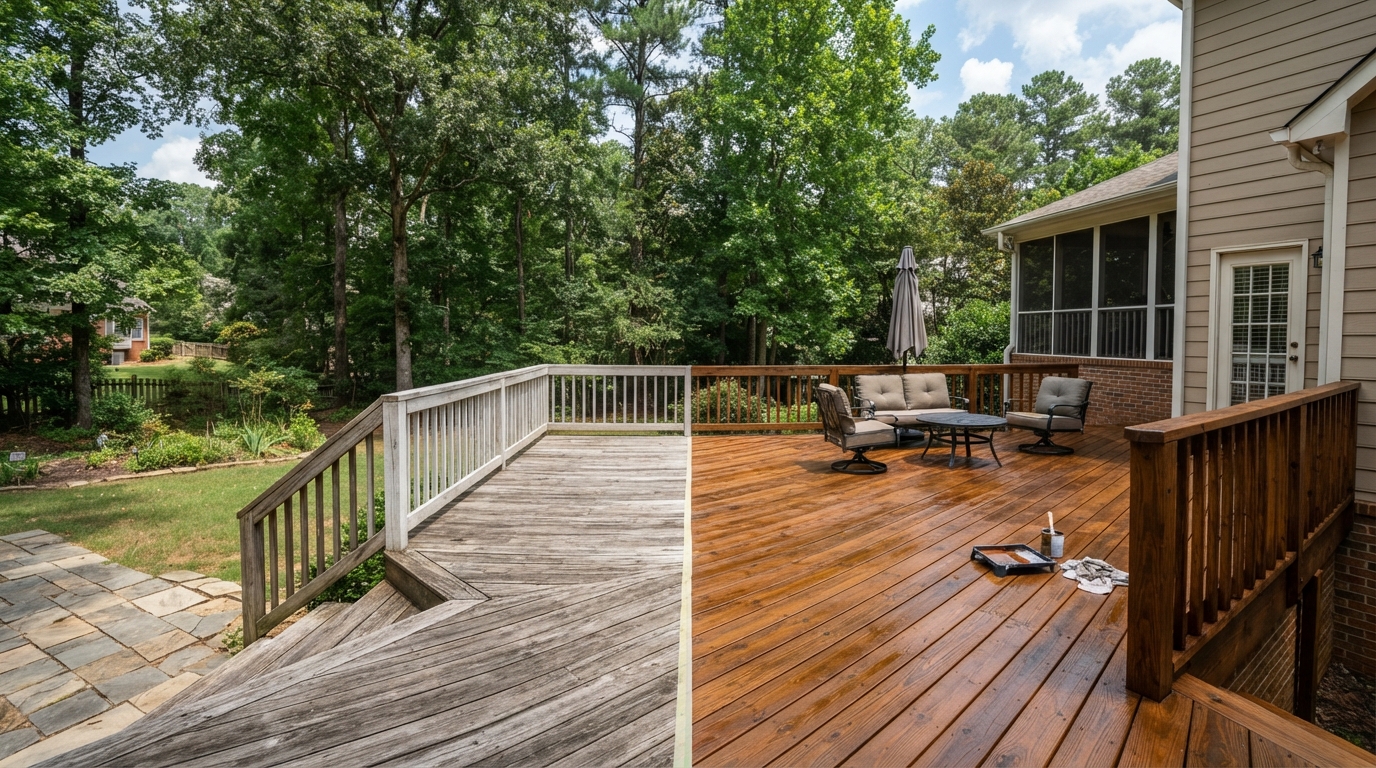
Deck Power Washing and Staining Cost Guide (2026 Pricing)
Real 2026 pricing for deck washing and staining in Cumming and Forsyth County. Broken down by project size, wood condition, and the factors that actually drive the number on your quote.
Average Deck Power Washing and Staining Costs Break Down by Project Size
Your deck's probably gray right now. Maybe green in the corners. Could be both. If you're somewhere in Cumming, GA or across Forsyth County trying to nail down what this project actually costs before somebody shows up with a pressure washer and a vague estimate, we're going to give you real numbers. We handle these jobs constantly, and deck size drives the price more than almost anything else.
A small 200-square-foot deck off a townhome costs a fraction of what a sprawling 600-square-foot wraparound runs. That gap is real. Homeowners nationally spend between $250 and $1,200 for deck washing and staining combined, with most projects landing somewhere in the middle depending on square footage and condition.
Here's what most cost guides get wrong. They hand you a flat per-square-foot number and call it a day. But a deck that hasn't been touched in four years takes way more labor than one that got cleaned last season. We see this constantly. A homeowner gets a quote based on size alone, then can't figure out why the number shifts once we show up and the wood is gray, fuzzy, and pulling apart at the edges. Call us at (404) 632-8810 for an honest on-site assessment.
Small decks, roughly 100 to 250 square feet, are the simplest jobs. Power washing goes fast. Drying time is predictable. Stain application is straightforward. Often single-day projects. But even a small deck in rough shape can pile on labor hours you wouldn't expect. Last spring we worked a 180-square-foot deck in Cumming where the previous stain had peeled so badly we needed two full cleaning passes before we could even think about stain.
Mid-size decks, 250 to 500 square feet, are the most common project type we handle. This is where variables stack up fast. Multi-level decks fall into this range often, and each level adds complexity. Railings, stairs, built-in benches. They all increase the surface area beyond what the floor plan suggests. A 350-square-foot deck with a full railing system and two stair runs is not the same job as a flat 350-square-foot rectangle.
Large decks, 500 square feet and above, almost always span two days if you do them correctly. The wood needs time to dry thoroughly after washing before stain goes down, and rushing that step on a large surface leads to adhesion problems later. Improper prep is the leading cause of premature stain failure on exterior wood surfaces.
Deck material plays into this too. Pressure-treated pine is the most forgiving and most common around here. Composite decking gets washed but never stained, which changes the scope entirely. Hardwoods like Ipe or Tigerwood require lower pressure settings and specialty stains, affecting both time and material cost. We've worked on a handful of Ipe decks in newer Forsyth County neighborhoods, and the labor time reflects the extra care required.
Square footage on a deck is almost always underestimated. People measure the floor and forget the railings, the fascia boards, the stair stringers. On a 400-square-foot deck with a full perimeter railing and one stair run, the actual stainable surface can easily reach 550 to 600 square feet once you account for all the vertical surfaces. We measure everything before quoting. It's the only way to give you an accurate number.
Understanding how size and condition interact gives you a realistic picture before anyone shows up at your door. If you want to see how these factors apply to your specific deck, our deck staining service page walks through what the process looks like from start to finish.
Key Factors That Change Your Deck Washing and Staining Price
It's not priced by the job. It's priced by the details, and those details vary a lot from one Cumming, GA property to the next. Here's what actually moves the number.
Deck Size and Layout
Size is obvious. Layout is the part people miss. A flat, open rectangle is the easiest deck we work on. Simple as it gets. But we see a lot of decks in Forsyth County with built-in benches, pergola posts, angled boards, or multiple levels connected by stairs. Each of those features adds time, and more time means more labor cost. The average new deck in the U.S. runs between 300 and 400 square feet, but the layout matters as much as the total footprint.
Stairs. That's the one thing most homeowners underestimate. Each step has a riser, a tread, and two side stringers. Four surfaces per step. Think about that for a second. A two-story deck with a long stair run adds a significant chunk of time to any job, and we hear that surprise from homeowners pretty regularly.
Wood Type and Current Condition
The species matters. Pressure-treated pine absorbs stain differently than cedar, redwood, or hardwoods like Ipe. Ipe is dense enough that it requires specific prep and a penetrating oil finish. Standard stains just sit on top and peel fast. We've seen this mistake on decks in newer Cumming subdivisions where the builder used exotic hardwood for aesthetics but the homeowner had no idea it needed different care.
Condition is the bigger variable, though. A deck cleaned and stained two years ago needs a light wash and a maintenance coat. Quick job. A deck untouched for five or six years, sun-bleached, gray, oxidized, maybe some mildew creeping into the corners? That's a completely different project. Aggressive cleaning, possible brightening with a wood brightener, full stain application. UV exposure and moisture cycles here in Forsyth County wear a deck out faster than most homeowners expect.
Cleaning Method Required
Not every deck gets power washed the same way. Soft washing, lower pressure with a cleaning solution, is the right call for older wood or decks with significant mildew. High pressure on weathered wood can raise the grain, splinter boards, and leave furry fibers that won't hold stain well. We've had to go back and sand decks that other crews blasted at too high a PSI. Extra labor. Totally avoidable.
Georgia's climate makes mildew and algae a near-constant issue. The humidity from late spring through early fall creates ideal conditions for biological growth on wood surfaces. That growth has to be fully killed and removed before staining. Seal mold spores under the finish and the stain fails early. Period. Working decks across Forsyth County, this is the step that separates a stain job that lasts three years from one that peels in six months.
Stain Type and Number of Coats
Solid stains cover more and require more product. Semi-transparent stains penetrate deeper but may need two coats on thirsty or weathered wood. The number of coats directly affects both material cost and dry time. In summer heat, you sometimes can't apply a second coat the same day without trapping solvents, and that means a return trip. That scheduling reality is built into how we price jobs.
The stain decision isn't just aesthetic. It's a maintenance decision. Solid stains hide grain but peel rather than fade, which makes them harder to maintain over time. Semi-transparent stains show more wood character and tend to wear more gracefully. We walk every homeowner through this before we ever open a bucket.
Access and Site Conditions
Access to your deck affects job time more than most people realize. A ground-level deck with clear open space around it is the most efficient setup. But a lot of decks in Forsyth County neighborhoods sit elevated above grade, back up to steep hillsides, or are bordered tightly by landscaping beds and fencing. Tight access means more careful equipment positioning, slower movement around obstacles, and extra prep time to protect surrounding surfaces.
Power Washing Alone vs. Staining Alone vs. Doing Both Together
Same mistake. Every spring. Homeowners here in Cumming, GA and across Forsyth County either blast the deck with a pressure washer and call it done, or slap a fresh coat of stain right over a dirty surface. Both shortcuts cost more in the long run than doing the job right the first time. Here's what each approach actually does. And what it doesn't.
Power Washing Alone
Power washing strips mold, mildew, algae, and years of ground-in grime. That matters beyond the cosmetics. Moisture-trapping organic buildup accelerates wood fiber breakdown faster than UV exposure alone. So washing has real protective value.
Most guides skip this part. Power washing opens the wood grain. The fibers swell and lift. Stop there without sealing or staining within a reasonable window, typically 24 to 72 hours depending on humidity, and that open grain becomes a direct pathway for moisture. You've basically prepared the wood to absorb damage instead of repel it. Not great.
We pulled a job last summer on a Cumming neighborhood deck where the homeowner had power washed in April and never followed up. By August, the boards had gray-checked and two of them had started to cup. A simple stain application after washing would've locked that moisture out entirely. Fixable situation. Didn't have to happen at all.
Power washing alone makes sense in exactly one situation: a mid-season rinse on a deck that was properly sealed less than a year ago.
Staining Alone
Staining over a dirty or weathered surface is one of the most common deck mistakes we see. The stain bonds to whatever's sitting on top of the wood, not the wood itself. So it bonds to mold spores, oxidized gray fibers, and old failing stain. The new coat looks fine for about one season. Then it peels in sheets.
Georgia's climate makes this worse. Forsyth County gets real humidity swings. Hot and wet summers followed by drier, cooler winters. That expansion and contraction cycle is brutal on a stain layer that never properly bonded. Surface preparation is the single biggest factor in how long an exterior wood finish lasts. Not the product. The prep.
Staining alone without washing first is almost always a waste of money. There's one exception: brand-new pressure-treated lumber installed within the last few weeks that's never been stained. And even then, most installers recommend waiting 30 to 90 days for the wood to dry before applying any finish.
Doing Both Together
This is the approach that actually protects your investment. Wash first. Let the wood dry completely. Then stain. The wash removes everything that would prevent proper adhesion, and the stain penetrates clean, open wood fibers and forms a real bond. The sequence matters as much as the steps themselves.
We've seen homeowners reverse the order. Stain first, then decide to wash. And the pressure washer strips the fresh stain right off. Two days of work and product cost gone in twenty minutes. The order really does matter.
Doing both in the right order extends the time between maintenance cycles. A properly washed and stained deck in Forsyth County's climate holds up noticeably longer before needing a full recoat, compared to a deck that was only partially treated. Decks that receive combined cleaning and sealing treatments are refinished less frequently over a ten-year period than those receiving single-service treatments alone.
Ready to Get a Quote for Your Deck?
One complete job now beats two partial jobs later. If your deck is past the point where a garden hose and an afternoon feel like the right answer, call us at (404) 632-8810 or request a free quote online.
OCB Pressure Washing handles deck power washing and staining for homeowners throughout Cumming, GA and Forsyth County. We measure everything before quoting, assess your wood condition in person, and give you an honest price before any work starts.
Frequently Asked Questions
Ready for an Honest Quote?
Get a free, no-obligation estimate on deck washing and staining in Cumming and Forsyth County. We measure everything on-site. Family-owned. Fully insured. Trusted since 2009.